No More Strings Attached
Or, "If you choose not to decide, you still have made a choice." (Rush: Free Will)

Kathy and Nick were in the living room with my husband Jeff, working up a set or two of music to play out on the back deck. No particular agenda.
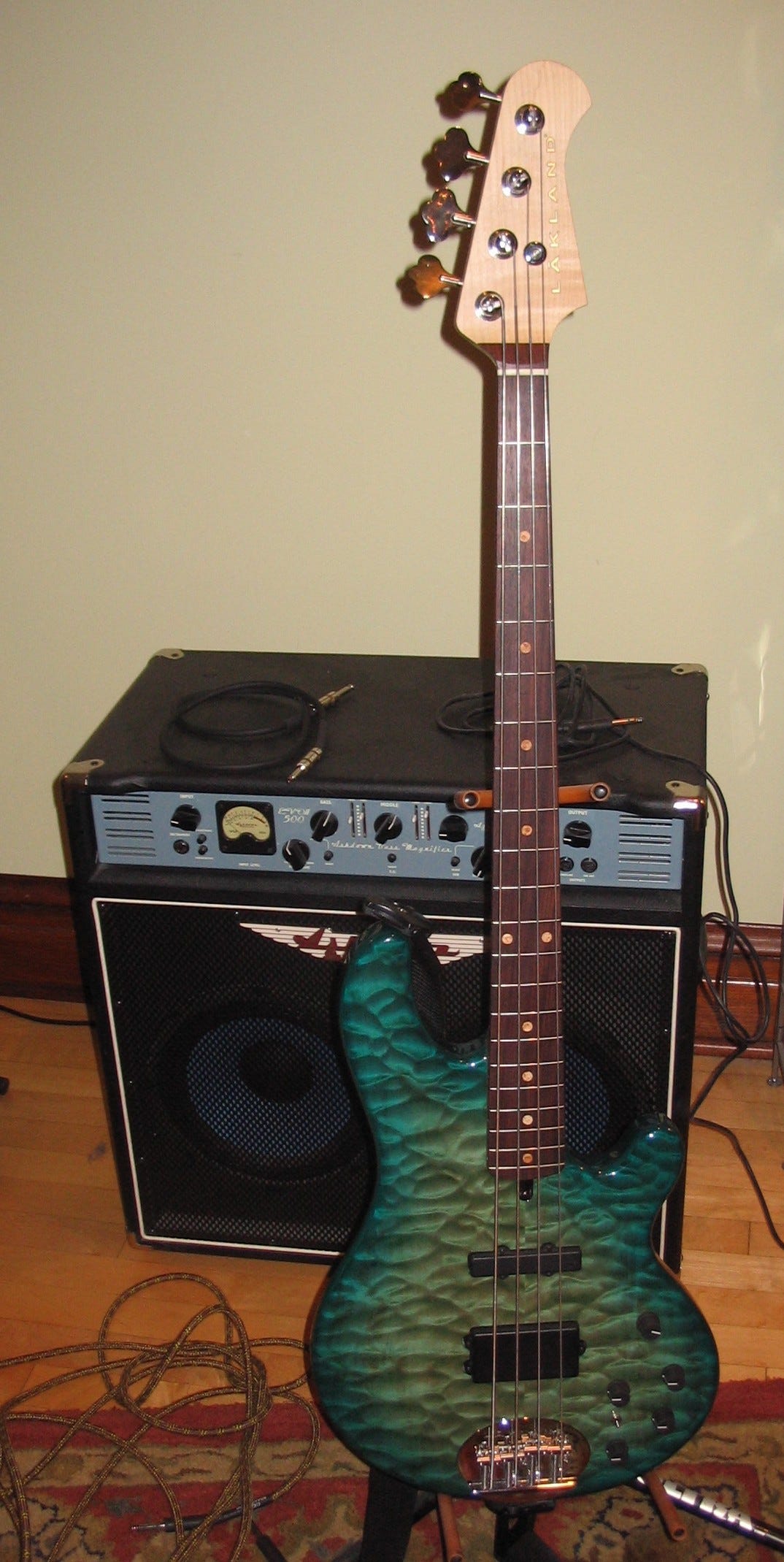
I grabbed my bass off the wall and sat down to play and—I just wasn’t feeling it. It was like the three of them were in a fishbowl happily swimming around while I flopped around on the outside looking for a way in.
***
I learned to play bass at age 40, during my world-class midlife crisis. I was dating a musician who had a three-room rehearsal space on the second floor of a factory not far from Chicago’s meatpacking district.
One night, tired of my campfire guitar playing, he took me into one of the rehearsal rooms, put his beat-up black bass in my hands, stood me in front of his bass rig—two 15” Eden speakers, stacked, powered by an Ampeg SVT4 head—and turned it all the way up.
I plucked the E-string, felt the air from the two big speaker cones whoosh into my back, and that was it. I put down the guitar and never looked back.
Over the next five years, outside my day job in IT at an ad agency, bass became my life. I played bass two, three, four hours a day. I listened to music and meticulously deconstructed bass lines. I interviewed bass players for bass guitar magazines. I worked freelance for a bass guitar manufacturer.
If you know me, you know I do nothing halfway. If I’m in, I’m all the way in.
The boyfriend assembled a band, and we played out a couple of times a month. Parties. Small community events. Some early shows at Betty’s Blue Star Lounge where we actually got paid. Not a lot. Breakfast money. Still, it was a thrill. I got a lot of attention. I was a chick bass player who could actually play.
Then, I was an insider—100%.
Photo Credit: ID 205300654 © Rafael Da Silva Pereira
It was fun to be on stage but I soon discovered that my memory was not reliable when it came to retrieving three sets worth of memorized bass lines—unless I spent hours upon hours driving them into my fingers. And while this issue wasn’t that hard to hide in a band that wasn’t that good, I knew from my interviews with professional musicians that once I got with better players it would be game over—quickly.
A couple of bands and another bass player boyfriend later, an opportunity opened up to audition for a noted Chicago blues artist. Was I good enough? If I could remember the freaking parts, absolutely.
However, that gig would also involve playing until 5am three nights a week at a blues bar and then going to a day job, which is what the band leader, a CTA bus driver, had been doing for decades.
If my memory was better I might have gone for it. Retrospect, it’s probably a good thing my memory wasn’t better. The blues scene is rough. (IYKYK.)
I continued to play and practice, doing little gigs with some local musician friends but as the years passed it was feeling more and more like work with no real reward.
Still, I had this skill I had invested years in developing and it seemed like a waste to just walk away from it.
I told myself I needed an $800 Taylor GS Mini acoustic/electric bass because it would allow me to practice and play unplugged might entice me to re-engage, and it did.
I used it to learn the original bass line to “Walk Don’t Run,” an instrumental 60’s surf tune by The Ventures from YouTube. I took it to Jeff in hopes we could play together. We quickly discovered he had learned a different arrangement in high school jazz band. To make it work, I would have had to learn a different bass line and what little energy I’d managed to gin up went out of it.
***
So, as I sat in with my friends and my spouse trying to find some way to contribute to a half dozen songs I’d never heard much less played before I realized this: Save for the four songs whose bass lines are driven so far into my muscle memory I could play them dead drunk and laying on my back, playing mostly just stressed me out now, and with few exceptions, it had done so for a while.
Dropping in on new songs and having to figure out something to play on the fly is sort of SOP in jam situations and I used to get some reward from my ability to make the music feel good with my limited chops. And there is value in that but it got to the point where that was the only situation I was ever in.
Some people just like to play and don’t get too wrinkled up if it doesn’t sound perfect.
The problem is I know what it’s like to be well-rehearsed and play so well that there is that little pause before people start clapping because you and your bandmates commanded all of their attention and they need a few seconds to come back to earth.
My professional musician friends will know exactly what I’m talking about. They’d also tell you to create that, everyone has to be all in.
***
This outsider-y feeling has arisen before and in the past I’ve doubled down and pushed my way back in.
My response this time was to take the dog and go upstairs to our room and close the door. Open up my laptop and spend the time writing. Doing my art, all the way.
Right here. On this page. With you.
And with that act, I let the bass go. I did it without swearing it off or taking any oaths. I’ll play or I won’t and I’m just not going to mind what happens with it anymore.