
My Dad was an engineer at Ford and a crack mechanic—the quintessential “car guy.” And like most car guys, he liked to have a project car.
One time, he took me on a ride around the block in his 1950 Studebaker Champion. He’d removed the back seats to replace the carpeting, so I was standing on the floor behind him, hanging onto the back of his seat. Totally illegal, even in 1967. I’m also sure Ma was not home.
This was before he built the garage and I think Ma got sick of it and all of its various parts and pieces cluttering up the driveway, so he got rid of it. (FYI, well-restored Studebaker Champions now go for around $17,000.)
For a time, he settled for tinkering with our existing cars, adding a fake hood scoop to our powder blue 1970 Ford Maverick (when Maverick was a car) and painting the area around the taillights black.
Then, in the spring of 1977, a buddy of Dad’s showed up with a trailer and deposited a 1966 Ford Mustang in our driveway. I have to imagine there was some negotiation with Ma that it would live in the garage when he wasn’t working on it, and it did, most of the time.
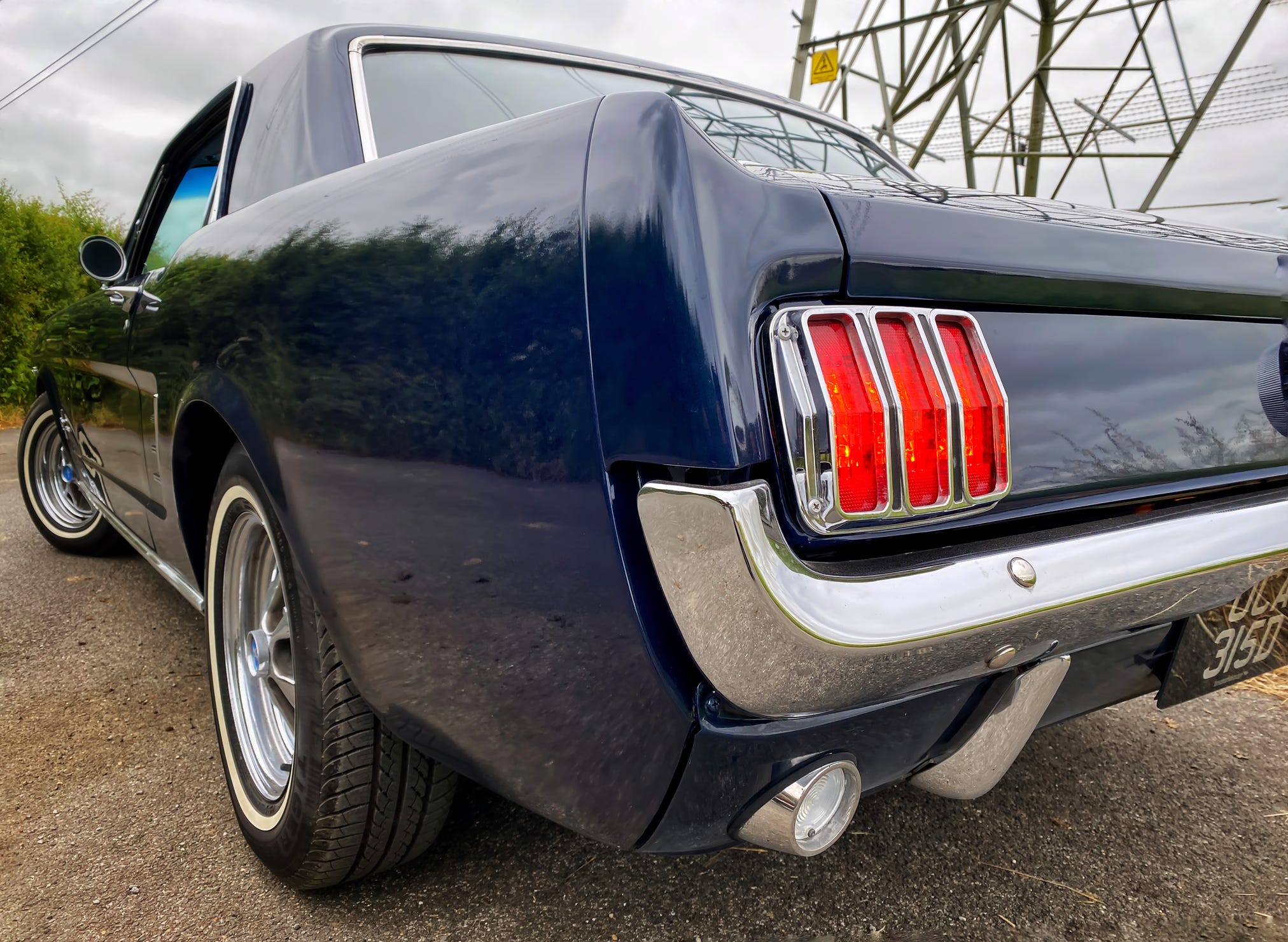
ID 240878690 © Paul Hildreth | Dreamstime.com
The car was dark blue (likely Caspian Blue Poly 12547) with a dingy white faux leather roof. Rust—everywhere. Inside, the headliner and carpet were filthy but the turquoise and white seats and door panels—Mustang’s premium “Pony interior”—were intact and fairly clean. It also had the center console option, which cost $51 ($500 in today’s money). Standard gauges.
I spent that summer out in the driveway helping Dad grind off rust and patch holes in the fenders with coffee cans and pop rivets. (Resourceful, yes. Recommended, no.) We then applied (a lot of) Bondo to the new metal, sanded it, and smoothed it all out as best we could with glazing jelly followed by wet sanding with a fine grit paper.
It was hot, dirty, dusty work—and I loved it. It created so many opportunities to hang out with my father where we worked together quietly, speaking only about the tasks at hand.
Dad continued to tinker with the car, and I continued to help where I could until the fall of 1980 when I went off to college. While I was away, he pulled the gas tank, which had a leak, and created a temporary fuel source, a small red metal gas can that held about two gallons, which he tucked inside the engine compartment.
Completely safe. Ahem.
That said, I should tell you that Dad was a product development engineer, which is a specialized role responsible for inventing ways to adapt things the product designers drew so they actually worked in the real world. So, he did know what he was doing. The purpose of the temporary tank was to be able to continue work on the new 302 cubic inch (~5.0L) engine he’d put in, since the original 289 (~4.7L) V8 was seized.
At some point the car (with its temporary tank) got trailered down to Ohio to a relative who had converted their one-car garage into a paint booth.
So…when painting with a paint sprayer, unless you know how to control for all the various factors, you end up with an uneven surface sometimes referred to as “orange peel.” I know this because in art school I had to paint a ton of product models, and learning how to set up the sprayer properly, hold it at the correct angle, and get the right amount of paint on evenly was part of the process. (It’s really hard!) Orange peel can be overcome but it requires wet-sanding and polishing the whole car to even out the surface. Let’s just say in this case, the juice was not worth that squeeze.
Anyway, the car was trailered back to Michigan and put back into the garage, where it sat. And sat. And sat. And Dad didn’t do another thing with it for the rest of his life.
Still, he couldn’t let it go. When my parents moved back to Ohio in 1994, the Mustang went into the semi, along with 16,000 pounds of other stuff (a real number) and he paid $300 a month for its storage for the next 22 years.
To be clear, this is a man who would have, had Ma permitted it, repaired his sneakers with silver duct tape rather than buy a new pair. I know what you’re thinking. Trust your instincts. And read on.
***
In 2016, my parents passed on within four months of each other, even though my father was 12 years older. After Dad died (he went first) I told my sister I’d start cleaning out the storage units.
I took the keys to the storage unit off the hook on the refrigerator at my parents house and headed over to the facility to assess the contents of what had over the past 22 years expanded from one to three storage units. I knew one of those units had the car in it. I didn’t know what I would find in the other two but given I’d found 12 hammers after just a few hours sorting through my father’s workbench in the garage, I braced myself.
My cousins Jeff and Tommy offered to help. We started with the most recent unit first. It was an odd collection of items that included an antique wood burning stove, several bicycles he had intended to repair and give away, a mountain of lawn mower parts, garden implements, and old oil cans. In the corner was his acetylene torch and two tanks still on the original dolly. (We spirited that thing out of there post haste—without the manager seeing it.)
The second unit was full to the rafters. Dad was an avid junk picker. Everything was a future project or something someone might need some day. I didn’t recognize anything in the first or second layer but then I saw the red tractor—the one that I used to help him cut grass down at my grandmother’s place in Massillon.
The gas in the tank had turned to varnish and its big back tires were flat. I said we should find someone to fix it and give it away. Tommy, who had a lawn mowing business, said no one would want it. Somehow the three of us heaved it into the back of Jeff’s truck and he hauled it to the metal scrapper.
A piece of my heart went with it.
There was one unit left to look through and it was the one with the car.
I managed to get the door unlocked but had to go get the manager to help me roll it up because it had been so long since anyone had been in there.
The car was covered with dust inside and out (the driver side window had been left open an inch). The tires were flat.
There were some surprises. For one, he’d saved the original 289 engine! The original hubcaps were in the back seat.
I was expecting memories to pour forth. Maybe some tears. Instead there was just—gravity.
I pulled the door to the unit down, replaced the lock, and got back into my car, where I sat and thought about the car and my Dad for a long, long time.
***
It was the middle of October, about two months after Ma died, when my sister Lisa called me at home, then in New Jersey. Interim, my cousins had made dozens of trips to the scrapper and the dump and they had gotten most of the stuff out of two of the three units. Similarly, they’d filled the tree lawn up at my parent’s house with junk six weeks in a row, which the North Royalton sanitation workers graciously made disappear.
Lisa said, “Listen, I need to know if you are going to take the Mustang or not because Jeff knows a guy that really wants it and who said he’ll finish the restoration and take it to car shows.”
I told her to give me a day and I’d let her know for sure this time.
Dad would have wanted me to have that car, and I really wanted it, if only for that reason. The problem was I wasn’t skilled enough to complete the restoration myself and to have someone else restore it right would cost thousands. Plus, I had no place to park it so it would have to go from one storage space to another and that didn’t seem right, either.
My sister called again the next day and said I had to decide because they were emptying all three storage spaces by the end of the month. Then she said this: “Look, Jeff said the guy who wants it said he’d restore it and name it after Dad.”
I grew up in the garage working on cars, hanging out with car guys working on cars, and going to art school with car guys, so I knew what it took to do a restoration like that. Dad had gotten the car running, but in mechanic speak that just means the engine turned over and stayed on. It still needed a real gas tank. Was this guy a mechanic? I didn’t know. Then, there was the body, a whole other skillset. The paint issues could be overcome, but the minute he discovered the coffee cans and pop rivets it might be game over.
Still, I chose to believe, so I could let it go.
I still think about the Mustang from time to time.
What I’ve realized is this: The car may be gone but what it meant to me didn’t go anywhere.
I took that with me.