
In June of 1912, my grandfather, Joe Bouchez, age 14, had just completed the 8th grade. Like many of the boys in the small central Illinois town where he lived, rather than return to school in the fall, Joe followed his father into the coal mine. Likely he started out sorting shale from coal up top and later worked down below as a miner’s helper. This I inferred from my research on coal mining as according to my Dad, Grampa never talked about it.
Joe’s father, Louis, was born in Pâturages, Belgium (now known as Colfontaine) and came to the U.S. in 1885 when he was about 22. His mother, Sarah Simonin, was born in Sorrento, Illinois. She married Louis in October of 1897, and Joe was born in July of 1898. His two sisters, my aunts Sylvie and Adelaide, came later, in 1904 and 1907.
Sarah’s father, Victor, was also a coal miner but he had immigrated to the U.S. from Haute Saône, France in 1865, when mining wages were higher and working conditions were better. He was able to purchase some houses to rent and some land where he kept a small plot to farm and a few milk cows.
Mining in the early 20th century was an increasingly unstable occupation. There were strikes and injuries, and in Louis’ case, the tavern. Sarah was a very smart and capable person who, like most miner’s wives, did all kinds of things to keep the family afloat. In addition to taking care of kids and keeping house, she rented out her father’s houses, bred the heifers to get calves to take to market, and went with the doctor to help women deliver their babies.
She was also determined that Joe and his two sisters would have a better life and she knew the only way to do that was through education.
At that time, the best way to get that education was through the International Correspondence School, a pioneer in distance education founded in 1909. In 1914, at age 16, he undertook the certificate program for Mining Engineering. The hope was that it would allow him to become a foreman at the mine and not have to spend so much time in the pit.
This is my favorite receipt from the stack that were in my grandfather’s personal effects, which my Dad passed onto me.
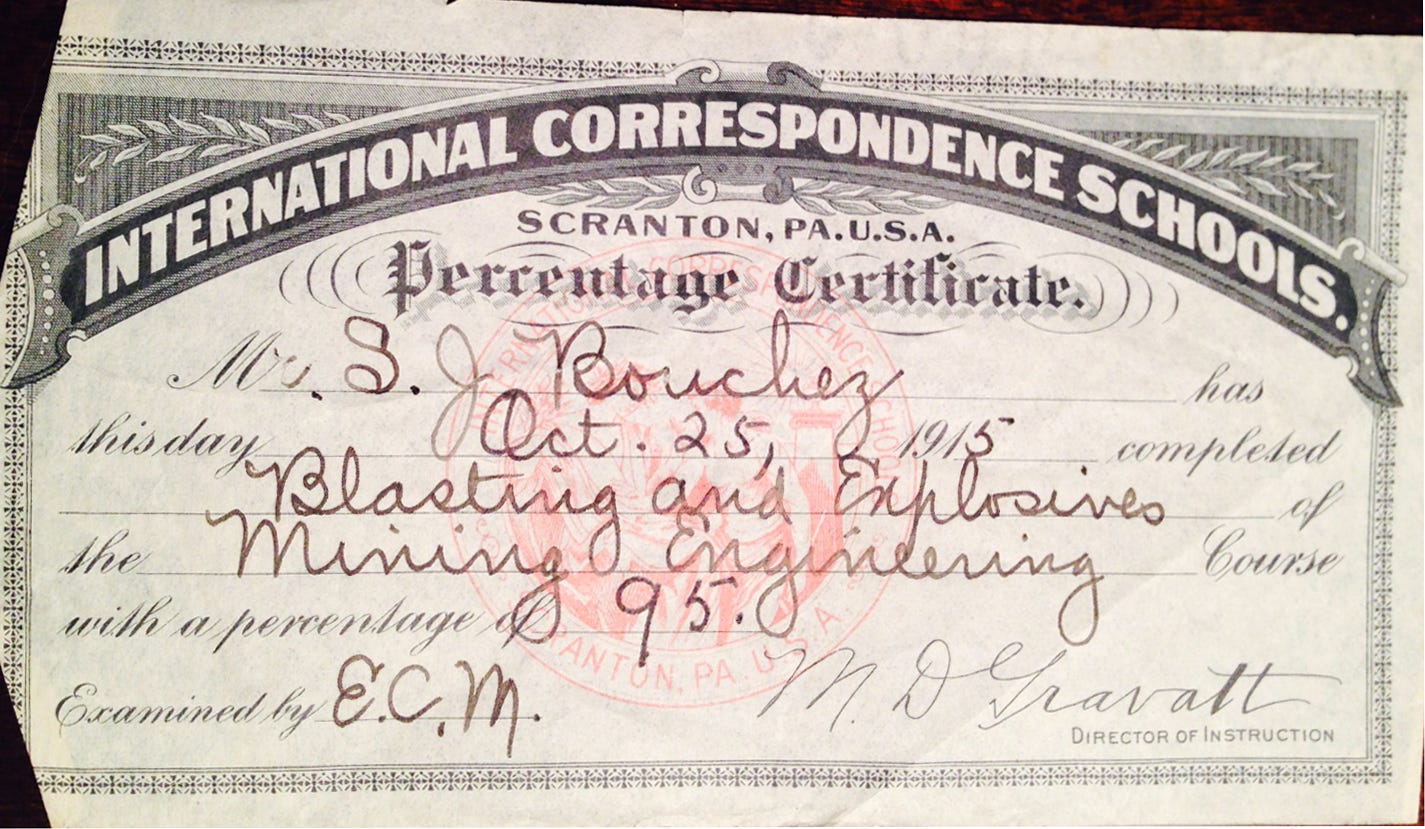
An ICS course cost about 120 dollars, which was expensive but doable because the school had taken a page out of the Singer Sewing machine marketing strategy and let students break it up into installments and pay over time.
Joe was bright and applied himself and so passed the exams with high marks. Based on the dates on the exam receipts, it took him almost three years to get through it.
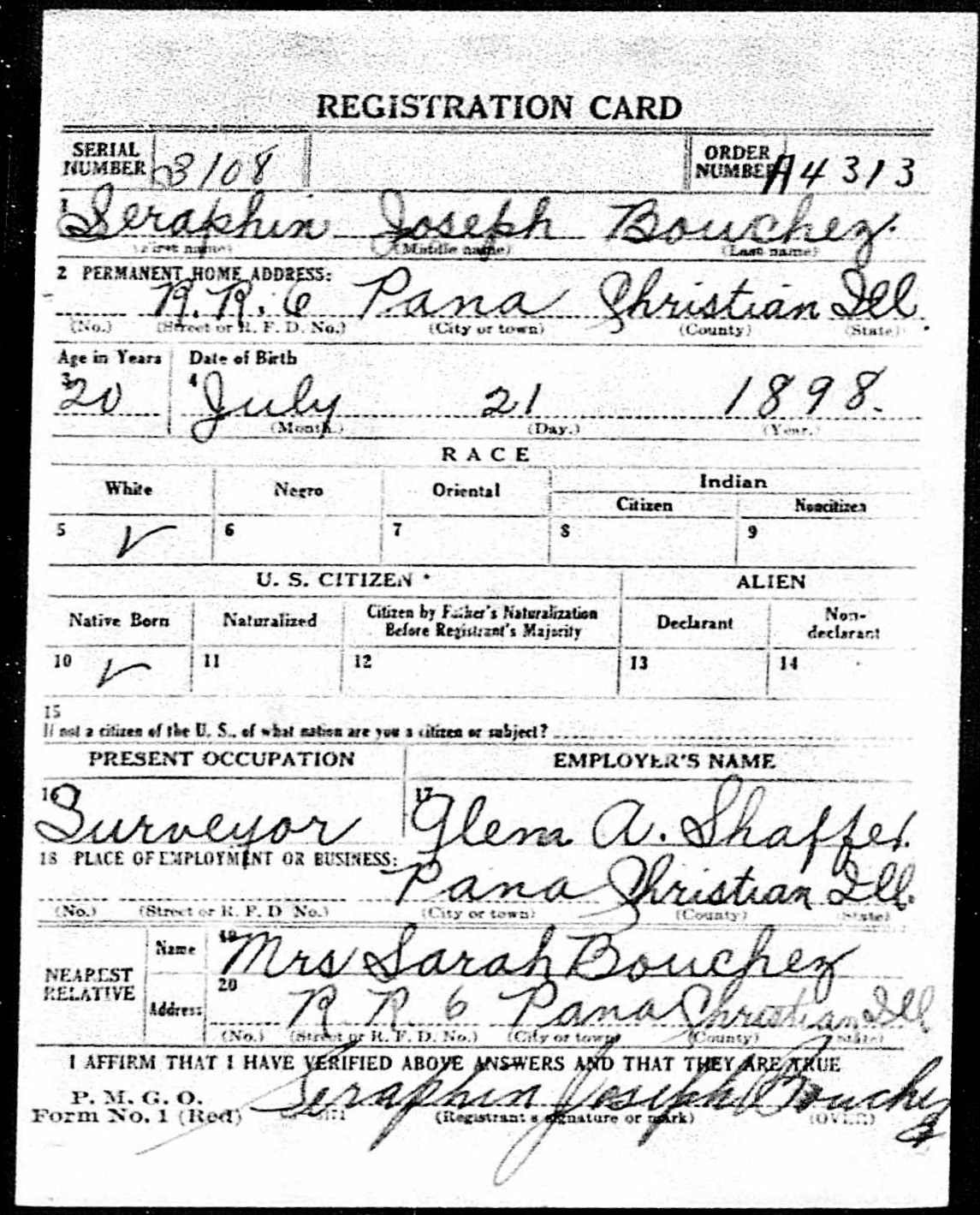
Oddly, out of the 40 classes required for this course, the receipt for the surveying module was the only one missing. Then, through research, I found his 1918 WWI draft card. There his occupation is listed as—surveyor.
Education, in combination with his efforts and desires, allowed Joe not only to lift himself out of the mines, but out of labor completely. Ultimately, he would become an engineer, and hold two patents. The journey was more complicated than that of course, but the point is, Joe was the first person in 12 generations who did not work his entire life as a miner because he had access to education.
Joe wasn’t the only one whose life was forever changed by this access. His two sisters, Sylvie and Adelaide went to nursing school, which allowed them to remain independent. Sylvie became an operating room nurse and hospital administrator in Vandalia, Illinois, and never married. Adelaide worked as a nurse for a time, and then as a sales person. (She did get married but not until she was in her 40’s.)
Joe’s son Russ (my Dad) and his two daughters (my aunts Margaret and Irene) were the first to go to college, and my Dad was determined that my sister and I get our degrees as well. My sister plowed through her degree in three and a half years. I got mine too, though my path was not nearly as straightforward!
My sister and I both have our own businesses now, which is another conversation entirely, about the paradoxes of independence and responsibility, and the need to coexist among the strange bedfellows that are safety and risk, as we tread that path.
Would we be here without the education we received at those institutions of higher learning? In my case, no. Having a degree checked a box that eliminated a barrier and allowed me to compete for employment that led to projects that led to key connections with people who have been pivotal in my success.
Just like that ICS course eliminated a barrier that allowed my grandfather to compete for employment that was done in the sunlight, instead of by lamplight.