Chasing “IT”
We all have a zone of genius. This is how I got back to IT.

While transportation design instructor Homer LeGassey (who was also the architect of the school’s transportation program) never tore my gouache rendering off the wall and threw it on the floor, he did draw on one with a fat black marker.
Homer had walked by my drawings with little or no comment for weeks, and those in the know knew that was not a good thing. The fact he took the time to correct this one meant he finally saw something there worth correcting. Which I inferred to mean I was getting better. Either that or he was just throwing me a bone. Either way, it was appreciated.
So much of the talent in that room was incredible and the drawings reflected this. The forms, elegant. Perspectives, perfect. Renderings, beautiful, with the requisite star shaped “bird shit” highlights placed just right.

Photo by Ashwin Vaswani on Unsplash
My forms were pedestrian at best and the depiction of them flat as a pancake. (I never did figure out the highlights. And don’t get me started on perspective.)
Point is, no matter how hard I worked, I could not conceive of those forms and even if I could, I couldn’t get them out of my head onto paper in a way that accurately—and aesthetically—communicated my ideas.
The problem: I did not have “IT.”
“IT” being the inherent magical sensibility, intuition and intelligence that when combined with stunning visual communication chops makes one a great designer and/or artist (most of the greats are both).
When it comes to visual art, not only do I not have IT. I don’t have It, or it, either.
You cannot manufacture IT. You either have IT or you don’t.
And I didn’t.
At the time, the Industrial Design program at Center (now College) of Creative Studies (CCS) had a forced attrition policy. They admitted 60 students per class but only graduated 13. We all knew this going in and worked like fiends hoping we would survive.
Alas, at the end of my fifth semester, the instructors reviewing my portfolio recognized my dearth of IT-ness and I was not invited back for a sixth.
Don’t feel bad for me. It was an experience! And I took with me what I learned about design thinking—in theory and in practice—and it has served me well ever since that fateful afternoon in December of 1985. In fact, everything good I have been able to create in my life is the product of the design thinking and problem solving skills I learned and practiced there.
In 2005, about 10 minutes after I started playing bass, I signed up to attend Victor Wooten’s week long Bass Nature Camp in Tennessee. Once again, 60 people, this time musicians of every age and ilk, who were hoping to accelerate their development under the expert tutelage of Victor Wooten, his brother Reggie Wooten, David Welch, Anthony Wellington, and the great Chuck Rainey.
The first afternoon we all played a little something. When my turn came I sounded—awful. I’d love to blame it on my instrument—for some reason I’d brought an unwieldy boutique 5-string whose tone I could not control vs. my steady 4-string Fender. And while that poor decision certainly contributed to my stress, it wasn’t the true source of it. I was in over my head.
Once again, I was an “it” in a room full of “Its” and “ITs”.
Sigh. I would just have to tough it out and absorb what I could. And I did just that. The theory classes were painful but there were also a lot of practical tips and tricks Victor shared that saved my ass on stage later.
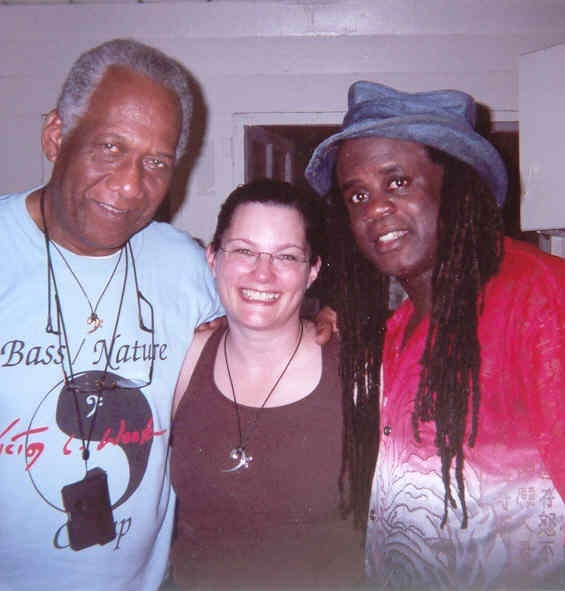
HB with Chuck Rainey and Reggie Wooten, July 2005 after a ripping fun final jam session where I held my own—barely. © LHelenaBouchez
Again, don’t feel bad for me. The friends I made there—David, Oz, Toné, and others—are still friends to this day. Plus, who else do you know who can start a fire with a twig and some string? (That was in the Nature part of camp).
I’ve played music in some capacity since I was six—ukulele, guitar, trumpet—so I am a musician. Plus, I loved the bass and was all in since I plucked the open E string while standing in front of two 15” cabinets and felt the air whoosh into my back.
In fact, I loved the bass enough that for the next 10 years I invested hours upon hours into practicing. More than one professional player I took lessons with told me I had “the part you can’t teach.” Meaning, I can make the music sound and feel good and I can play in what they call the “pocket.” And because I understand my role, I can do a whole lot with a little.
So, when it comes to the bass, I do have “It.” (I was just too green when I went to camp for it to show.)
What I did not have, nor would I ever have when it came to the bass, is “IT.”
This became abundantly clear during an interview I did with John Howard, a Nashville session musician and bassist for the band Sixwire.
First call session musicians are able to hear something once and play it back.
Me: nope.
They also can remember the basslines to thousands of tunes and when faced with something new can make a bassline up on the fly. They have auditory eidetic memories.
Me: nope.
When I asked John how much he practiced, he said, “Eight hours a day.”
That was a lightbulb moment for me. Because even if I did have IT, which I already knew I did not, I realized I was not willing to practice bass eight hours a day, even as much as I loved it.
What I was willing to do, and in fact at that point was already doing at work and with my freelance clients, was write eight hours a day, sometimes more.
Today, I make a good living as a co-writer and editor of nonfiction business books. And I’m blazing a path toward writing on my own account, which is what I’m doing here on Substack.
So, why so many detours? Why spend 10 years of art school and 10 years honing my bass chops? Why didn’t I just start out as a writer?
Well, I did. I started writing stories and poetry in the second grade. It just took me a while to get back to—IT.
The most interesting woman in the world?
I've tried a lot of things while looking for IT: graphic design, oncology tech, prison tutor, and a million other small jobs. I'm a bit of a dilettante - interested in a million things! This is why I love the intersection of gardening + education = the never-ending supply of new knowledge and the excitement of sharing it with others. Great post, Helena!