A Hobo Tale
Hopping on the genealogy train to find out more about my ancestor and myself.

My great great uncle Frank Coughlin, the fifth of seven children born to wild west pioneer Michael “Cush” Coughlin and his wife Sophia, was intermittently a “knight of the road.” In other words, a hobo who road the rails.
In a 2003 interview, Todd DePastino, author of “Citizen Hobo: How a Century of Homelessness Shaped America”, said, “One famous quip had it that the hobo works and wanders, the tramp drinks and wanders, and the bum just drinks.”1
Frank worked and wandered. He would come home to Cleveland once in a while, his clothing so filthy his mother would make him take it off outside.
When his sister, my great grandmother, Margaret Grant Coughlin (middle name in honor of the Ulysses S.), asked how he was able to get along, he said that it was because he could read the signs.
Hobo signs.
Hobo signs are a system of symbols, often made with chalk or coal, used by travelers to communicate with each other about local conditions like safe places to stay, friendly people, or dangerous areas. More fascinating information about this here.
Signs could be combined. For example the stick figure with the triangles that means “Kind woman lives here, tell pitiful story” is actually a combination of two symbols, the stick figure “Kind woman” and the triangles, which mean “tell pitiful story.”
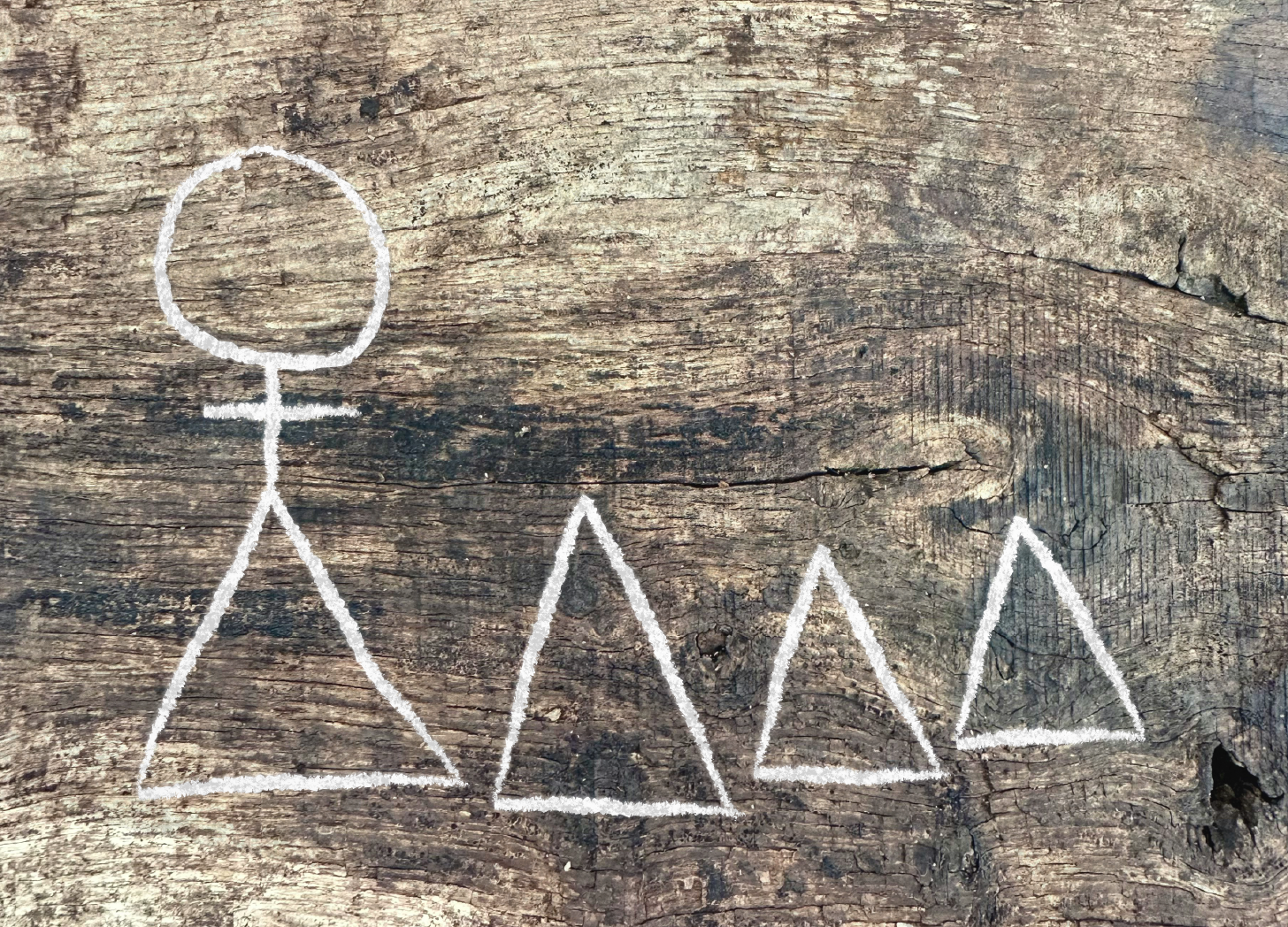
Image credit and copyright: Linda Marie Johnson
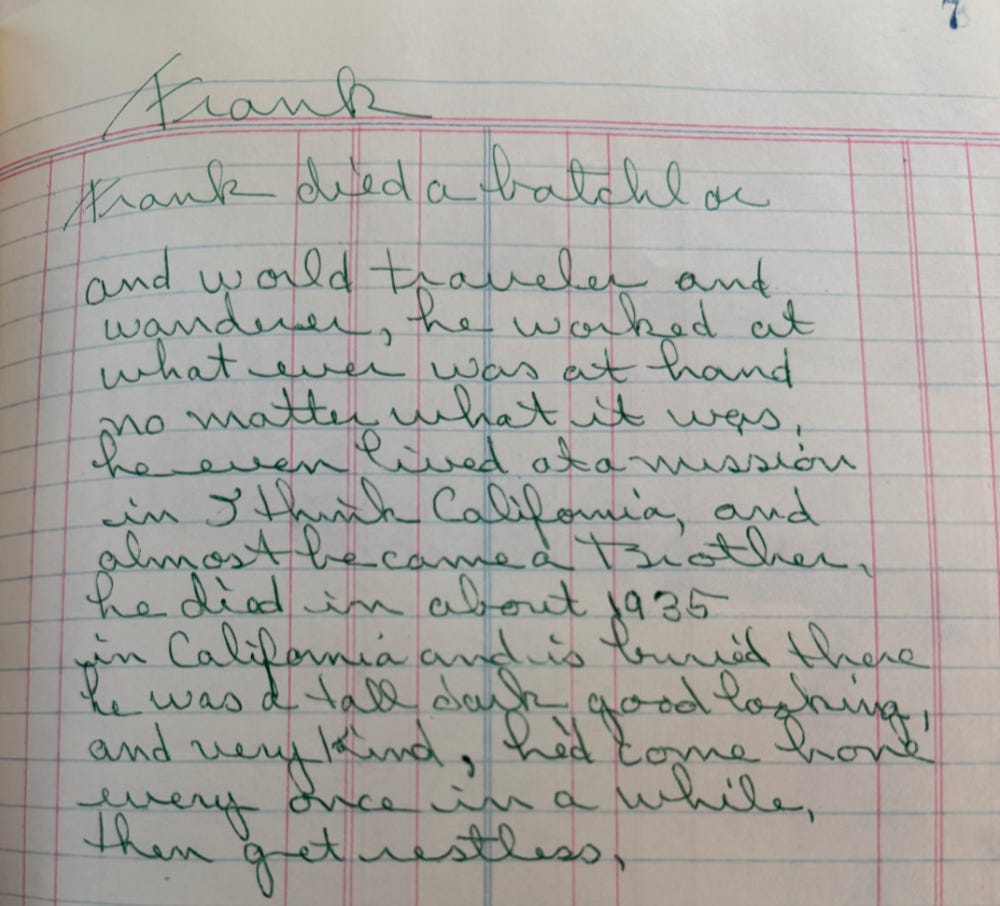
Luckily, Ma was also interested in her family history, and so asked her grandmother— the aforementioned Margaret Grant Coughlin (who we all knew as Grama Lillie)— to write some things about her family. Here is what she said about her brother, Frank.
I’ve been interested in genealogy since I was 12, so I had the chance to talk to both Grama Lillie and my (great) Aunt Bess about their family. Bess was actually a better source because she was less prone to sugar coat the truth to preserve your opinion of someone. But when asked why she thought Frank wandered, even she said, “You know, that’s just how he was.”
On the 1920 census, Frank is listed as living with his parents and driving a truck, but after that paper trail goes cold—except for a single image of an index card found on Ancestry.com. According to this sparse record, Frank died on 28 May 1935 (he was just 40 years old). The card also indicates he was interred at St. Joseph Catholic Cemetery in Woodland, California, plot 244.
So, that’s where he died in California but we still don’t know why, or how. To find that out, I need to see his death certificate. I ordered it just now from Vital Check. They said it will take about 90 days. Given he’s been gone 90 years, I think I can wait. But I’m curious to see what it says.
When I dive into an ancestor’s history, I’m filled with empathy for who they were and what their life was like. What made Frank wander? How did the overall family dynamic impact him. His siblings. And their children.
And ultimately, how does my awareness of his life and choices impact my experience, and the person I am.
A kind woman, for example.
Just don’t try telling me a pitiful story.
I’ll make you a sandwich.
But that’s it.
UPDATE: I was able to obtain Frank’s death certificate from the state of California. He entered Yolo County Hospital in Yolo County, California on May 25, 1935 and died on May 28, 1935 at 6:25pm from kidney failure caused by pyelonephritis, a serious kidney infection and cystitis, a bladder infection, which led to uremia. His occupation was listed as painter, and he lived in what is now known as West Sacramento. Marital status, mother and father were all marked “not known.”
Hoboes, bums, tramps: How our terminology of homelessness has changed on the National Coalition for the Homeless website, accessed December 5, 2025.
There's great episode of Mad Men that illustrates the kind of parents the protagonist Don Draper had growing up in the 1930-40s. A hobo comes by their farmhouse and works for his supper, later sleeping in the barn. The next day, when Don's father refuses to pay the man for his labor, the hobo leaves behind a mark representing "a dishonest man lives here". I absolutely love this kind of storytelling - a scene that tells you everything without explaining it all. I suspect there's a certain romance to having no responsibilities, but I need more human connection and comfort. I can be cold OR wet, but not both at the same time.
In telling the tale looking backward, there's something romantic about the idea of riding the rails, reading the signs, and finding work as it came. In reality, it was probably messier and more painful.
That restless streak in Uncle Frank sounds like someone who just couldn't find a proper fit when it came to traditional roles. Reminds me of the poem "The Men Who Don't Fit In," by Robert W. Service (1911):
There’s a race of men that don’t fit in,
A race that can’t stay still;
So they break the hearts of kith and kin,
And they roam the world at will.
They range the field and they rove the flood,
And they climb the mountain's crest;
Theirs is the curse of the gypsy blood,
And they don’t know how to rest.
If they just went straight they might go far;
They are strong and brave and true;
But they’re always tired of the things that are,
And they want the strange and new.
They say: “Could I find my proper groove,
What a deep mark I would make!”
So they chop and change, and each fresh move
Is only a fresh mistake.
And each forgets, as he strips and runs
With a brilliant, fitful pace,
It’s the steady, quiet, plodding ones
Who win in the lifelong race.
And each forgets that his youth has fled,
Forgets that his prime is past,
Till he stands one day, with a hope that’s dead,
In the glare of the truth at last.
He has failed, he has failed; he has missed his chance;
He has just done things by half.
Life’s been a jolly good joke on him,
And now is the time to laugh.
Ha, ha! He is one of the Legion Lost;
He was never meant to win;
He’s a rolling stone, and it’s bred in the bone;
He’s a man who won't fit in.