A Book of Work
A Belgian miner's journey (1874-1885)

Livret des ouvriers were official “work booklets” issued by the local government in France and Belgium throughout the 19th century. Workers were required to submit these booklets to their employers, who used them to confirm their identity and work history.*
This is a photograph of the first page of the livret issued in July of 1874 to my great grandfather, Louis, by the province of Hainaut in the arrondissement of Mons, Belgium. He was 11 years old.
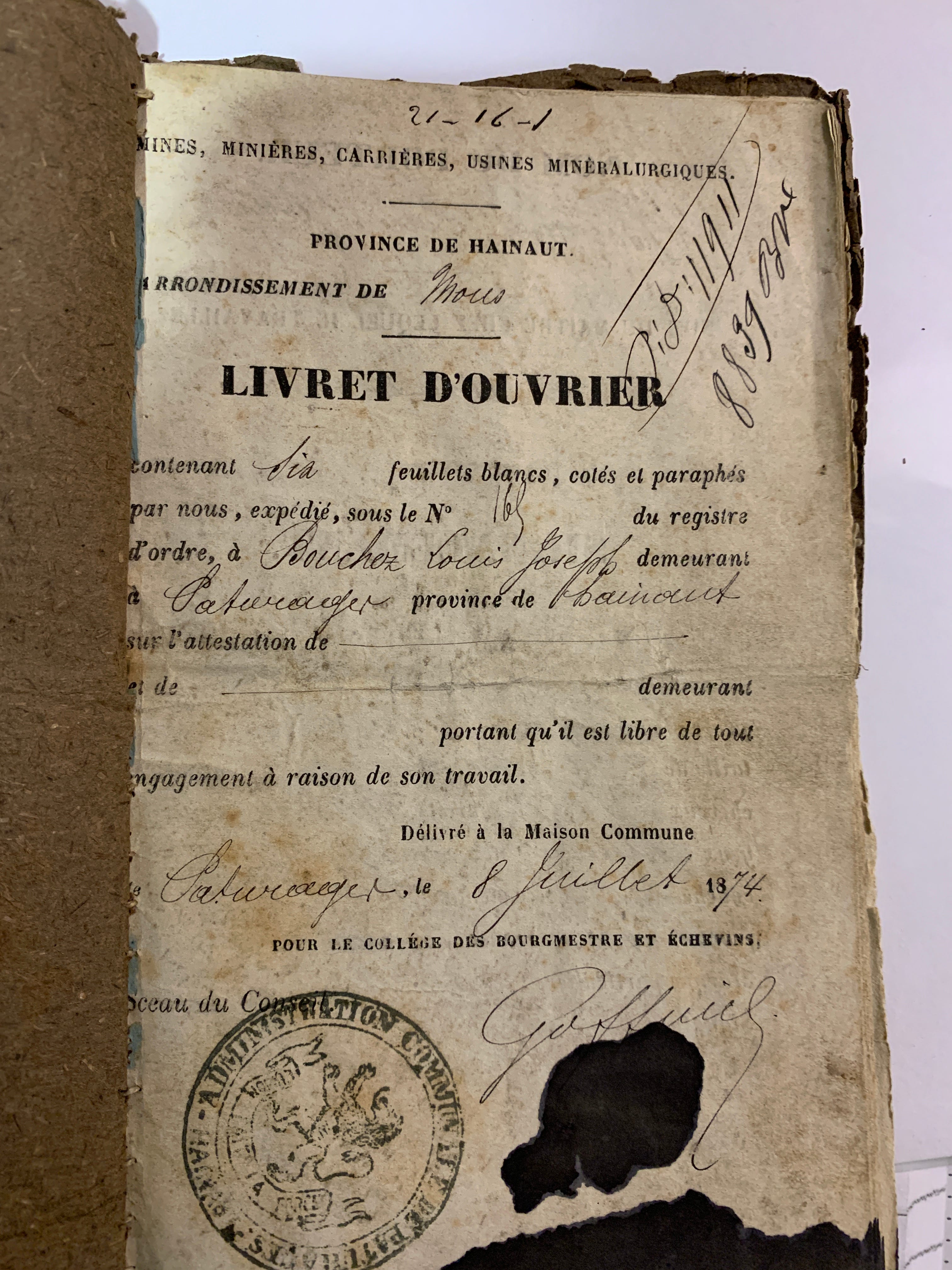
Image ©L. Helena Bouchez 2025
Louis likely started out as a breaker boy. A breaker boy’s job was to pick rocks from coal traveling through a chute below them as it passed. Ten hours a day, six days a week.
He would then have progressed to door boy, whose mind numbing job was to open and close the door to the mine. Then mule driver, whose job it was to drive the container of coal out of the mine so it could be hauled to the top for sorting. Then miner’s helper—a laborer and apprentice, and finally, miner, whose job it was to liberate the coal from the rock with a pickaxe and/or explosives.
It wasn’t until 1884 that Belgium passed a law prohibiting boys under 12 and girls under 14 from working in mines but these rules were often ignored because many families still needed the child’s income. (1) It wasn’t until 1914, when Belgium implemented compulsory schooling, that the practice of child labor was finally ended.
Employers not only recorded and validated the beginning and end dates of each work engagement, they also held onto the booklets for the duration.
The livret d’ouvrier functioned as a tool of social control and enabled industry and government to effectively restrict and control the movement of workers.
When a worker wanted to travel outside the immediate area, he had to go to his employer and retrieve his livret d’ouvrier — and would have to notify his employer where he was going so they could release him. Those without a valid livret d’ouvrier could be arrested for vagrancy.
In Victor Hugo’s story Les Miserables, set in 1815 France, policeman Javert asks Jean Valjean for his livret d’ouvrier. As a parolee, Valjean has no livret, only a yellow “feuille de route” also known as a “passeport jaune” (yellow passport), which immediately identifies him as a former convict.
Created by the French regime in 1803, livret des ouvriers were temporarily abandoned in 1830 after mine workers destroyed their livrets during riots at Borinage. However, an 1840 royal decree by King Leopold I of Belgium incorporated the livret d’ouvrier into Belgian law, and livrets became widespread there after 1845.
The first engagement in my great grandfather’s book is 16 July 1874 – 19 August 1874 at Produits Colliery in Belgium.
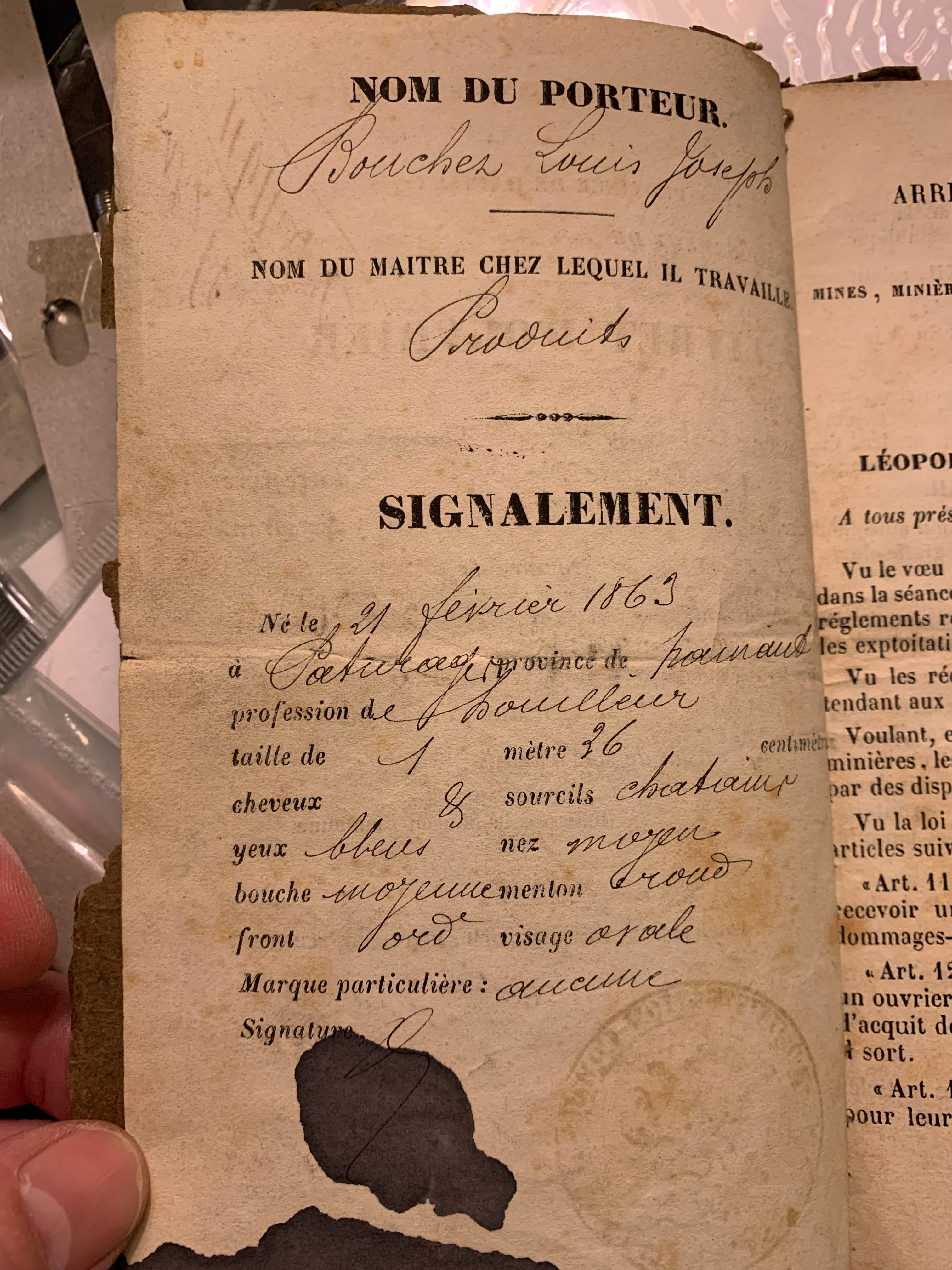
Image ©L. Helena Bouchez 2025
Between 1874 and 1884 there were several more engagements; those I can make out include Belle et Bonne, Mines de Escarpelle, Mines de Lievin, and du Charbonniere Douaisienne.
In 1879, Louis’ father, Seraphin, moved the family—who had lived and worked in Pâturages (now part of Colfontaine) for at least 11 generations—to Hersin-Coupigny, Pas de Calais, in the north of France to work in the mines there but it was no easier.
Belgians got the most difficult jobs for the worst wages. And the French workers basically hated them. Management’s habit of hiring Belgian miners to replace French strikers, did not help!
The final entry in Louis’ livret was in 1884: “Vu a las Mairie du Hersin-Coupigny” literally “To see the Mayor of Hersin-Coupigny, Pas de Calais.” This entry coincides with the date of a letter of good character Louis obtained in preparation for his immigration to America in 1885 to work in the mines in central Illinois.
There’s much more to this story, ex. my discovery by trawling the baptismal records online at genealogy sit Family Search that were were actually seven children born, four of which died before they were two years old. Only the second (Louis), fourth (Adolphe), and fifth (Albert) children survived. All three worked in the mines. Two of the three (Louis and Albert) immigrated to the US.
I have been researching my ancestors on both sides since I was a teenager. For many reasons, it’s this line I connect with most. Over time, I’ll unpack more of this history and its impact on future generations and you’ll see why.
Every time I write about these people I feel so incredibly grateful and fortunate to have been born in 1960’s U.S. instead of 1860’s Belgium. Just sayin’.
Anyone else have miners in their ancestry?
* This essay includes only one citation. It was something I originally wrote for fun, so don’t come for me. I have the research documents saved. When I write the creative nonfiction book about this, I’ll just have to retrace my steps!
(1) https://www.belganewsagency.eu/compulsory-education-ended-child-labour-in-belgium
Wow, fantastic.